Education
Our school motto is “Discover potential, enjoy success, prepare for life”. We aim to provide a wide-ranging education based on one concept – meeting the academic, social and emotional needs of our pupils. Through this they can start to flourish, build resilience and character through experiencing success and then be ready on leaving us to progress to adult life at college and later employment and finally as future parents.
We have The Gables that caters for pupils from Year 3 to 7. From Year 8, students move to The Grange on the Main School site and this includes separate Key Stage 3 and 4 areas and a separate wing for our Enrichment groups.
The curriculum is delivered through everything the school does.
Academically the school uses three pathways to meet the needs of pupils, and pupils move between these pathways where best suited to meet their needs at any given time:
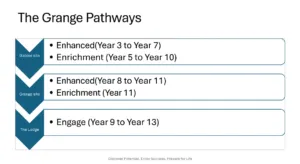
Curriculum Pathway: Enhanced
Overview
The Enhanced Pathway provides a broad, balanced and ambitious curriculum for pupils with SEMH needs who benefit from specialist support but are increasingly able to access learning within a more structured secondary model.
The curriculum combines academic achievement with continued development of emotional wellbeing, self-regulation and personal growth.
Intent
The Enhanced Pathway aims to enable pupils to achieve strong academic outcomes whilst continuing to develop the emotional skills required for lifelong success.
The curriculum intends to:
- deliver a broad and ambitious curriculum
- provide high-quality teaching that recognises SEMH barriers to learning
- promote independence and resilience
- develop emotional regulation and self-management
- prepare pupils for qualifications, further education, employment and adulthood
- encourage responsibility, positive relationships and community participation.
Implementation
The curriculum is delivered through:
- specialist subject teaching where appropriate
- consistent trauma-informed classroom practice
- high expectations alongside appropriate scaffolding
- explicit teaching of behaviour for learning
- personalised intervention where needed
- therapeutic support integrated into the school day
- regular academic and pastoral monitoring
- enrichment opportunities that build confidence and aspiration
- strong multi-agency working and family engagement.
Teaching maintains ambitious expectations whilst recognising that relationships remain central to learning.
Curriculum Pathway: Enrichment
Overview
The Enrichment Pathway provides a highly nurturing, relationship-based curriculum for pupils with SEMH needs, often linked to early childhood trauma, attachment difficulties and social communication needs. It is designed for pupils who have been unable to thrive within mainstream education or previous SEMH provisions and require a consistent, primary-style learning environment to rebuild trust, emotional security and readiness to learn.
Intent
The Enrichment Pathway aims to create a safe, predictable and emotionally secure environment where pupils can develop the foundations required for successful learning.
The curriculum is designed to:
- rebuild positive relationships with education through secure, trusting adult relationships
- develop emotional literacy, regulation and resilience
- address the impact of developmental trauma and attachment difficulties
- strengthen social communication and interaction skills
- provide high levels of nurture alongside academic learning
- close gaps in literacy, numeracy and wider curriculum knowledge
- develop independence, confidence and self-belief
- prepare pupils for successful progression into more independent learning pathways when appropriate.
Learning is underpinned by the principles of trauma-informed practice, nurture, relational approaches and child development.
Implementation
Pupils are taught through a primary class model, providing consistency, routine and a secure base.
The curriculum is delivered through:
- one class teacher supported by one teaching assistant for a maximum of six pupils
- a consistent classroom environment with predictable routines
- explicit teaching of emotional regulation and social communication throughout the day
- highly differentiated teaching matched to individual developmental needs
- therapeutic approaches embedded within everyday practice
- restorative and relational behaviour approaches
- opportunities for sensory regulation and movement breaks
- integrated speech, language and communication strategies where appropriate
- regular assessment of both academic progress and social-emotional development
- close collaboration with families and external professionals.
Academic learning remains ambitious but is carefully sequenced around each pupil’s emotional readiness to engage.
Curriculum Pathway: Engage
The Engage Pathway is the school’s most personalised curriculum offer, designed for pupils with the highest level of need whose complex SEMH presentations prevent them from consistently accessing group learning. EBSA prolife pupils are a particular focus for this pathway.
Provision is highly bespoke and centred around each pupil’s individual strengths, barriers and aspirations.
Pupils staying Post 16 also access this team as their aim is to help with independence –and support in stabilising college placements in Year 12.
Intent
The Engage Pathway aims to re-engage pupils with education through highly personalised learning, intensive relational support and carefully planned therapeutic intervention.
The curriculum intends to:
- remove barriers that prevent engagement with education
- rebuild trust, safety and emotional security
- meet pupils at their developmental rather than chronological stage
- provide flexible learning pathways based on individual need
- develop emotional regulation and resilience
- strengthen communication and interpersonal skills
- improve attendance and sustained engagement
- enable pupils to progress towards greater independence and participation within school life.
For some pupils, success is measured initially through engagement rather than academic attainment alone.
Implementation
Teaching is delivered through extremely small groups (maximum four pupils) with highly individualised planning.
The curriculum includes:
- personalised timetables and learning programmes
- flexible use of indoor and outdoor learning environments
- intensive relational practice
- trauma-informed and attachment-aware approaches
- therapeutic interventions integrated into the school day
- bespoke academic programmes matched to developmental stage
- individual behaviour support and co-regulation strategies
- opportunities for practical, vocational and experiential learning
- close partnership working with families, therapists and external agencies
- regular review of individual outcomes and provision.
The pace, sequence and structure of learning are adapted continuously to meet each pupil’s changing needs.
Qualifications
The qualification structure allows pupils to build confidence, recognising that many pupils have missed a large amount of school and may have a negative self-image of themselves as learners. Pupils have a clear, stepped progression starting with Entry Levels, then Functional Skills and finally GCSEs. This works at their pace however generally Entry Level English and Maths are completed in Year 8 and 9, Functional Skills L1 in Year 9and GCSE or Functional Skills L2 in KS4. NCFE L1 and L2 vocational and wider curriculum qualifications, including occupational studies, creative craft and animal care are completed in KS4. These qualifications are skills based and so they allow pupils to achieve them without narrowing the curriculum. In some subjects a separate exam board is used based on accessibility for pupils, for example pupils opting for further science will complete an Open Award Level 1 or 2. This builds confidence, allows them to change their self-perception and gives them the chance to celebrate success.
Some children are accepted into a Year group lower than their chronological age. This is agreed with local authorities, parents and is in the child’s best interest.
The Gables Curriculum – Enhanced and Enrichment
Gables site house two curriculum pathways, Enrichment and Enhancement. Enhancement pupils up to year 7 and Enrichment pupils up to year 10.
Maximum class size of 7 per tutor group.
The vast majority of pupils arrive at Gables Site below age related expectations. This is due to a combination of factors –for example their learning or cognition needs or having missed substantial periods of education due to previously being part time or not having a school place. The curriculum in Lower School aims to decrease these gaps and also help them progress in preparation for transition to Upper School. This is done by:
- High levels of support in the classroom
- Judicious use of one to one numeracy and literacy interventions, after an initial assessment
- Speech and Language interventions
- Teaching to “stage not age”
The broad curriculum also helps the pupils develop their social, emotional and character needs.
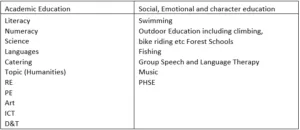
To support the pupils, the literacy and numeracy lessons take place in the first two lessons of the day and the classes become more kinaesthetic as the day progresses.
There are two pathways at the Gables Site – an Enhanced and an Enrichment. The Enhanced pathway of classes, is generally for pupils who are near or within 2 years of age-related expectations.
For the pupils with the most pronounced cognition and learning challenges and highest social and emotion needs we provide the Enrichment pathway, housed in the Gables house:
- High in class support
- Additional therapeutic input
- Additional targeted literacy and numeracy interventions
- Increased sensory support
Pupils are assessed on admission and allocated to the appropriate stream. Throughout their time at the school pupils can move between streams as they make progress academically and socially – most commonly pupils move from Enrichment to Enhancement.
In Year 7 pupils remain at Gables Site for an additional year. The rationale behind this is that this best supports their social emotional needs as the primary model, with the consistent teacher, provides reassurance and as the vast majority of pupils are behind age related expectations primary teachers are best suited to meet their academic needs. Pupils who are working securely at Year 7 levels receive the Year 7 maths and English curriculum through differentiation in the classroom. There is flexibility within the curriculum offer to join Enhanced pathway provision.
The Grange Curriculum Enhanced and Enrichment
The increasing age of pupils allows the school to expand the offer for pupils to include vocational subjects. These increase their understanding of possible future careers and help them make choices for Post 16.
Maximum class size of 7 per tutor group
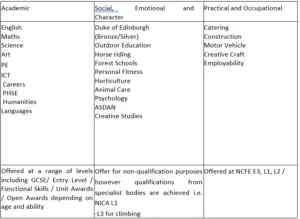
At the end of Year 7, pupils move into one of our Year 8 Enhancement or Enrichment streams based on their cognitive and emotional development. The move from Year 7 to Year 8 is planned across the final summer half term in a gradual manner to ensure a smooth transition and as little stress is placed onto the pupils as possible. The Year 8/9 pupils are then encouraged to develop and consolidate their key skills in core subjects and are also offered opportunities to extend their knowledge in other areas of the curriculum.
Students in Year 8/9 study a common curriculum consisting of Art, Careers, Catering, English, ICT, Maths, Humanities, Outdoor Education, PE, PSHE, Science and Forest Schools.
The final half term of Year 9 is geared towards preparing the students for the transition to KS4 and the start of their GCSE courses. Pupils at this stage are able to make the choices to personalise their learning for the beginning of Year 10. These choices run for one year and are then reviewed at the end of Year 10.
Social, Moral, Spiritual and Cultural (SMSC) aspects of learning and Social and Emotional Aspects of Learning (SEAL) are incorporated into planning across the curriculum as well as issues being addressed directly in the PSHE programme.
In KS4 pupils further specialise as they prepare for their transition to Post 16, college or apprenticeships. They complete more practical and occupational based learning through their chosen options – normally one day a week.
The Grange site houses one Enrichment class in year 11, this is with the aim of inclusion into essential key stage 4 provisions such as specialist work for transition to post 16.
The Lodge – Engage
Engage is offered to those pupils with highest barriers to learning, taking inspiration from research into Emotional Based School Avoidance the pathway aims to offer the most flexible and adaptable curriculum to address boundaries to learning before the curriculum. The curriculum offer is then tailored to the individual by encouraging options where possible and individual support where necessary. This is delivered by personal instructors with the support of specialists from across the school with planning, resourcing, delivery and assessment.
This will incorporate the same curriculum access as Enhancement at The Grange site, working closely with SLT and subject leads to ensure provision is accessible for pupils with specific need. The Lodge is able to access additional curriculum material where appropriate such as Beauty, this is overseen by the Engage Pathway Lead with support from Internal Quality Assurance for implementation.
This pathway is housed at The Lodge and takes pupils from yr9 to post 16. Pupils will have access to shared and individual spaces to create a safe environment to develop engagement in learning. Where appropriate, access to provisions (such as courses, groups, equipment) from across the Enrichment and Enhancement pathways are utilised. The aim is to ensure that pupils on this pathway are held within the school community along with the other pathways and that they are not isolated from the school.
Post 16
Post 16 is only provided for pupils already on roll at the beginning of Year 11 who are able to access local college provision. Post 16 provision utilises offsite provision only as a stepping stone to integration fully into college or apprenticeships
This judgement is made with the local authority, parent and social worker if appropriate. They may then stay at the school for Post 16. This can be a matter of months or up to 2 years. This is effectively an extension of their Year 11. Pupils are normally placed in supported college and work placements and also continue to study English and maths, however the work is designed to meet their independence deficits as well, so pupils learn how to travel independently and some are funded through their driving test if they live in particularly rural locations.
Destination Data 2025
Pupils who have left are now accessing educational programmes, qualifications and apprenticeships at the following colleges and FE establishments:
- North Warwickshire and South Leicester College
- Moulton College
- NACRO Education Peterborough
- Loughborough College
- West Anglia College
- Northampton College
- Homefields College
Destination Data 2026
Pupils who have left are now accessing educational programmes, qualifications and apprenticeships at the following colleges and FE establishments:
- Northampton College
- Peterborough College
- Brooksby College
- Transform College Leicester
- Cambridge Regional College
- Nottingham College
- Stone Lodge
- Push Forward Cambridge
- Tresham College
- Stamford College
- Stevenson College
- Seeds of Change
- Moulten College
Academic Results 2024/2025
Our 2025 Leavers achieved the following results;
• 100% of pupils entered achieved a GCSE in Maths (5 pupils)
• 100% of pupils entered achieved a Functional Skills Level 1 or 2 in English (5 pupils)
• 100% of pupils entered achieved an Entry Level Qualification in Science (6 pupils)
• 100% of pupils entered achieved a GCSE in PE (2 pupils)
Academic Results in 2025/2026
Our 2026 leavers achieved the following results;
- 100% of pupils entered achieved a GCSE in English Language (7 pupils)
- 100% of pupils entered achieved a GCSE in Maths (12 pupils, 1 Pupil Grade 6)
- 100% of pupils entered achieved a GCSE in Science (1 pupil – Biology, Chemistry, Physics)
- 100% of pupils entered achieved a GCSE in Art (1 pupil Grade 8)
- In English 11 pupils gained a Level 1 Functional Skills and 4 pupils a Level 2 Functional Skills
In Maths 5 pupils gained a Level 1 Functional Skills and 2 pupils a Level 2 Functional Skill